
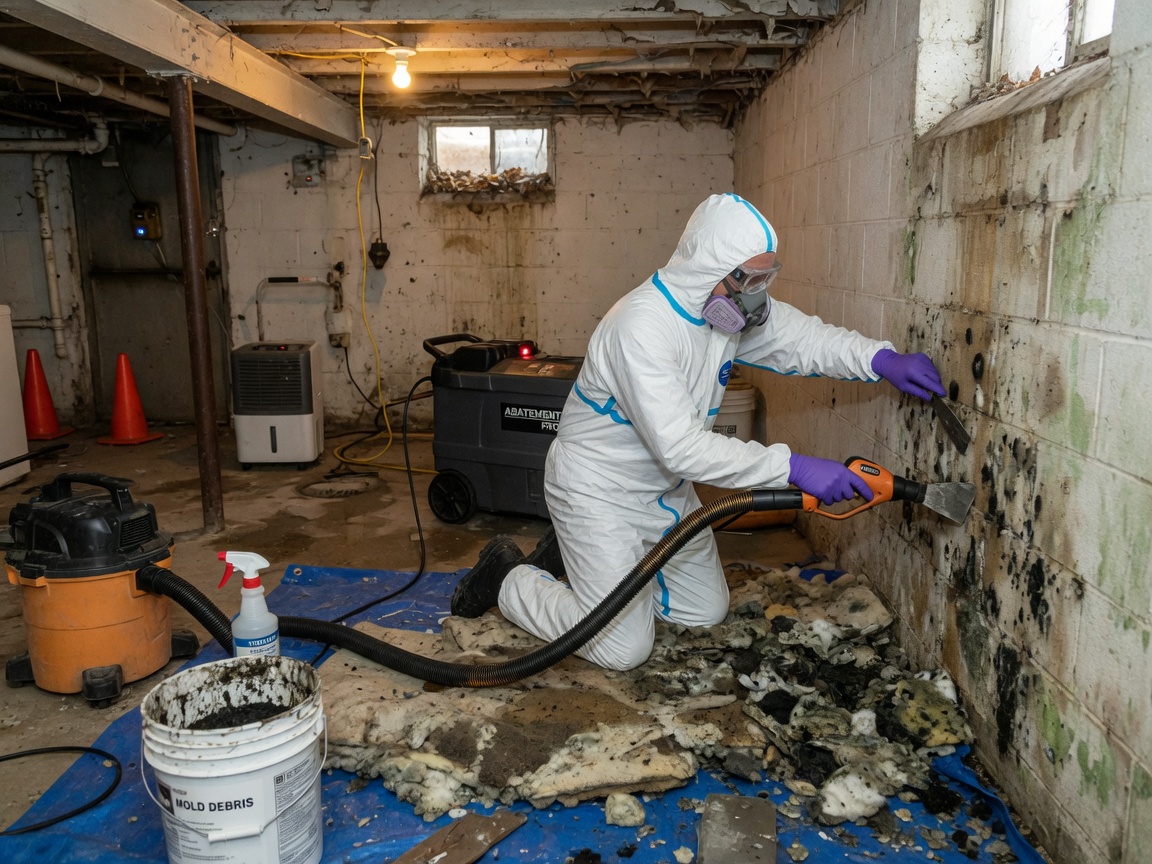
Midland's humid continental climate brings long cold winters followed by rapid spring thaws that push moisture through concrete and stone foundations common in Plymouth Park and Eastlawn homes. Water enters at cold joints and hairline cracks, then warm humid summers create the perfect conditions for mold colonies behind drywall and under floor joists. Technicians trace the actual water path rather than treating only visible growth, because untreated soil moisture from the nearby Tittabawassee River corridor keeps returning.
Many homes built before 1970 in Midland County have fieldstone or early poured foundations that lack modern damp-proofing. These surfaces hold residual moisture even after surface water is removed, allowing mold to regrow within weeks. Proper removal requires negative-air containment to protect living spaces above, followed by HEPA filtration and removal of affected porous materials down to the substrate. Skipping containment or drying steps simply moves spores into HVAC systems that serve the whole house.
After physical removal, technicians apply EPA-registered antimicrobials only to non-porous surfaces and then install targeted dehumidification sized for the basement volume. Homeowners in areas near the Tridge or Chippewa Nature Center often see repeated issues because sump pumps discharge too close to the foundation; redirecting discharge lines is frequently part of the permanent fix. Final clearance testing confirms spore counts match outdoor levels before any reconstruction begins.
Technician insight
In Midland, the thing that catches most people out with Basement Mold Removal is how our cold winters push condensation against older stone foundations in Plymouth Park and Eastlawn; homeowners often repaint or recarpet without fixing the moisture source and the mold simply returns the next thaw cycle.
Hidden Mold Behind Finished Walls After Spring Thaw
A homeowner in Downtown Midland near the Tridge noticed musty odor after the March thaw. Inspection found elevated moisture in the north foundation wall and mold behind paneling installed in the 1980s. Crew removed the paneling, dried the stone, corrected the nearby downspout discharge, and cleared the space with air sampling. No recurrence reported the following winter.
Basement Mold Removal Services We Offer
✓Basement Mold Inspection Midland MI
Moisture meter and thermal imaging scan of all foundation walls, joists, and behind finished surfaces to locate hidden colonies before any removal starts.
✓Negative Air Containment Setup
Sealed barriers with HEPA-filtered negative pressure that keep spores from migrating into living areas above the basement during demolition and cleaning.
✓Affected Material Removal
Controlled demolition and disposal of drywall, insulation, and carpet padding that cannot be salvaged, performed to IICRC standards.
✓Crawl Space Mold Treatment
Targeted remediation for low-access crawl spaces common under older Midland homes, including vapor barrier replacement and soil treatment.
✓Post-Remediation Drying
Commercial air movers and dehumidifiers run until moisture content in framing and subfloors returns to safe levels measured with pin meters.
✓Sump Pump Discharge Correction
Re-routing of sump lines away from the foundation to stop the repeated moisture that fuels mold regrowth after Midland spring thaws.
Basement Mold Removal Cost in Midland, MI
| Service | Typical Range | What Affects It |
|---|---|---|
| Initial Assessment and Moisture Mapping | $150–$300 | Includes thermal imaging and written scope; credited toward remediation if work proceeds. |
| Small Basement Section Remediation | $800–$1,600 | Up to 200 sq ft with limited material removal; common in single-room Eastlawn basements. |
| Full Basement Mold Removal | $2,200–$4,800 | Larger areas with multiple walls or crawl space access; price rises with finished drywall demolition. |
| Post-Remediation Clearance Testing | $250–$450 | Independent lab sampling required by many insurers and real estate transactions. |
Ranges are typical for Midland, MI and confirmed with an exact written quote before any work starts.
How it works
- 1
On-Site Assessment
Technician arrives within hours, maps moisture sources, and identifies all affected materials while the homeowner receives a written scope before work begins.
- 2
Containment and Air Scrubbing
Plastic barriers and negative-air machines isolate the work zone so spores do not spread through the rest of the house during removal.
- 3
Material Removal and Cleaning
Non-salvageable materials are removed, surfaces are HEPA-vacuumed and treated, and hidden cavities are opened until no visible mold remains.
- 4
Drying and Clearance Testing
Equipment runs until moisture readings are normal, then independent air sampling confirms spore levels match outdoor baselines before barriers come down.
Pricing
Upfront written quotes after inspection; final price depends on square footage, material removal volume, and any hidden cavities discovered.